
Whenever we enter a new year, we tend to make resolutions, set new goals, and reassess our values – all in the pursuit of a fresh new start that can infuse our lives with a bit of hope and positivity. This year, and over the last two years or more, talking about hope has become a lot harder against a backdrop of a world being burnt to the ground by elites.
Our news and social media feeds are filled with stories of hate, with Black and people of colour (BPOC), including children, being bombed, starved, worked to death, frozen in icy weather, kidnapped, and unjustly imprisoned. We are witnessing the collapse of international law and the rules-based order. While these frameworks have never fully served the safety and security concerns of BPOC communities, they have functioned as some form of guardrails against imperialism, neo-colonialism, and fascism. And, to top it off, we’re seeing extreme, state-sanctioned police violence against people protesting this collapse.
All of this can leave us feeling that there is no hope, that things are not going to change, and that we are powerless. Can we even dare to hope, to talk about hope, let alone hold on to it, without it sounding and feeling dissonant?
This past month, I have been grappling with this question and came across two quotes that shifted my perspective.
The first comes from Mariame Kaba’s hope as a discipline – a discipline that needs to be practiced every day. The basis of her take on hope comes from the belief that there are more people who want social justice and real systemic change than there are those working against it, and that we can change the world if we are organising and working as collectives and in community with one another.
The second comes from Nani Jansen Reventlow’s book, “Radical Justice”. In it, she talks about each of us being the revolution: we don’t need heroes to come and save us, nor do we have to wait for things to be perfectly aligned and planned. What is important, she says, quoting Audre Lorde, is that “[e]ach of us must find our work and do it. To refuse to participate in the shaping of our future is to give it up.” The subtitle of Nani’s book, Building the World We Need, captures the infusion of hope into the air we breathe.
These two takes on hope both centre the power of people to bring about racial, social, and economic justice through struggles for systemic change. I see this power every day in the work that we do at Systemic Justice.
There is something very unique about what we do at Systemic Justice, and that is centring marginalised communities in strategic litigation by introducing the law and the courts as an additional tool in their advocacy and campaigns toolkits. This approach is powerful because it puts the very law that has and continues to be used against marginalised communities into the hands of those communities. By doing so, it also challenges the structural power dynamics between the law, the courts, litigators, and marginalised communities.
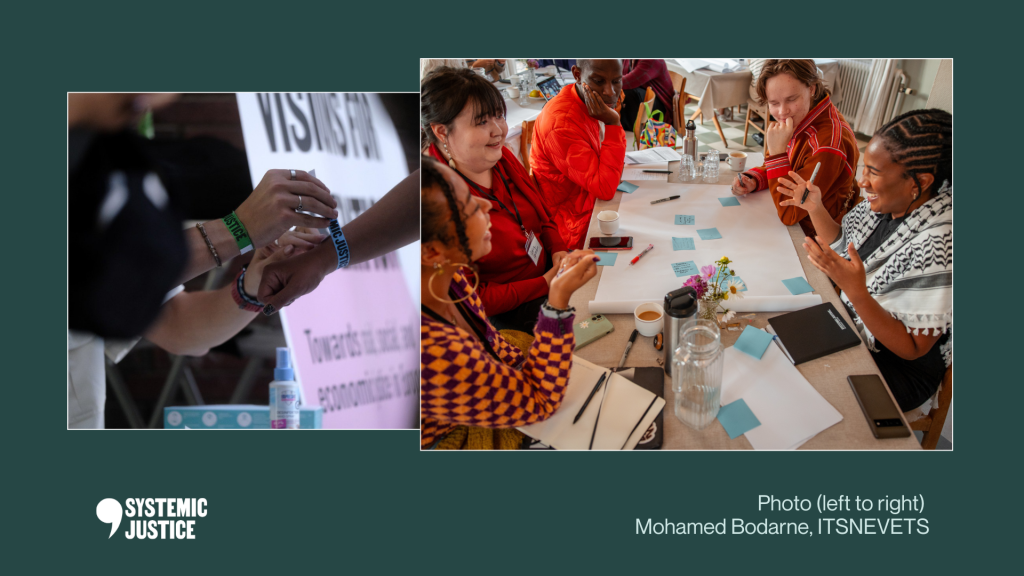
The hope I see in this work is Black and people of colour on the frontlines of the struggles for racial, social, and economic justice. With more to lose, they are still braving violent borders to attend a workshop to learn about how they can use the law and the courts in their day-to-day struggles to exist. I see hope in the time and energy that community-led organisations commit to strategise and build campaigns for systemic change, using the law and the courts to make the world even just a little better for their communities, while simultaneously having to do battle with the daily practices of systemic injustices. I see hope in the litigation organisations and individuals who show up in our Community of Practice because they too share the vision of a radically transformed legal sector and believe that another, better world is possible.
2026 is an exciting year for Systemic Justice and offers many reasons for hope. We are in a year of transitions. This year will see the launch of our next strategic plan, marking our move from our founding phase to our consolidation and expansion phase. We will also complete the joyful transition of our executive leadership.
During the year ahead, we will continue to build the knowledge and power of communities at the frontlines of the struggles for climate justice and social protection across the Council of Europe area. We are working with a number of organisations to support their readiness for strategic litigation, and we are hopeful that these struggles for systemic change will be heard in the courts. We will continue to work with litigation organisations and individuals to build and strengthen our Community of Practice. We also continue to strengthen and grow our team, always in a values-driven way.
This year also marks Systemic Justice’s fifth year from when it was birthed as an idea on the back of a napkin, and there is much to be proud of. We will be reflecting on the last five years, and sifting through the seeds that have been planted to see what we will take forward and strengthen in the five years ahead. We will be celebrating our foundation years and the incredible milestones that have been achieved in this short space of time, including being the first Black founded and majority BPOC organisation in Europe to use a community-driven, intersectional approach to strategic litigation.
There is much to keep us hopeful. And this hope lies in collective action and community-led struggles for racial, social, and economic justice. The power for change lies here, with us, in movement together.