

Words for justice: A glossary of essential legal terms
Explore our glossary of essential legal terms
Words for justice: A glossary of essential legal terms
Legal terminology, sometimes referred to as “legalese”, can often feel like a language of its own. The many words, terms, and expressions that are used by legal professionals to talk about legal processes and the courts can appear to make things harder, rather than easier, to understand. Access to this knowledge is often mediated by lawyers or legal advisors, which can lead to unequal relationships between communities seeking justice and their legal counsel.
Communities and movements are made up of many voices and experiences. When working together to drive racial, social, and economic justice through the courts, we need to have a shared understanding of words and their meanings.

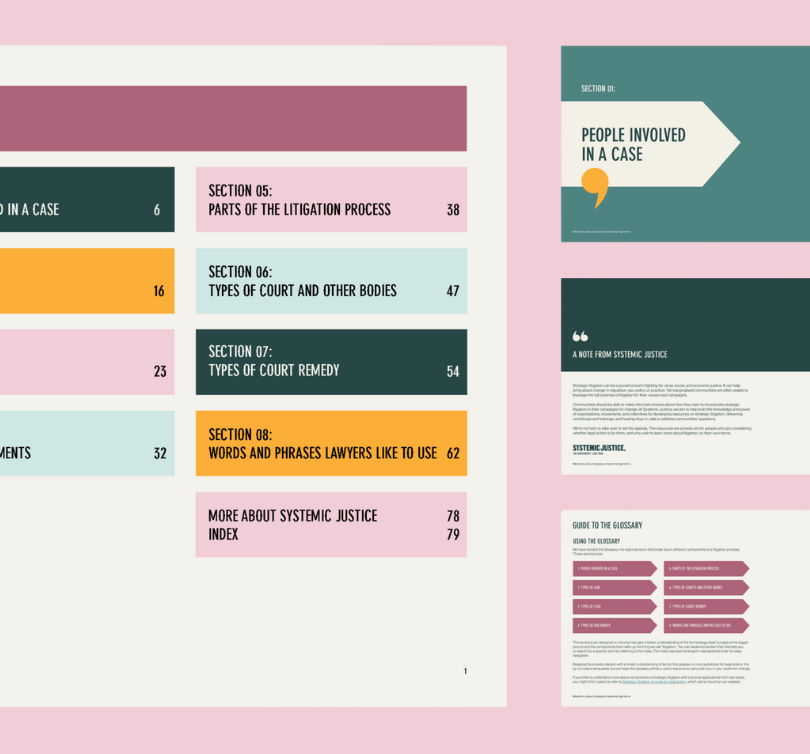
This resource helps communities understand legal terminology so they can consider legal tools and integrate them in their campaigns for change, on their own terms. An understanding of legal terminology is important for communities to sit firmly in the driver’s seat of strategic litigation and, beyond undertaking litigation itself, can also be useful to:
- integrate legal analysis in advocacy and campaign work;
- engage with legal developments in the courts;
- strengthen activism strategies;
- participate in public debate.
Download
Legal knowledge shouldn’t exclusively sit with lawyers or legal advisors. When it does, it cannot serve justice for all. Legal knowledge should be at the service of causes, campaigns, and communities fighting for racial, social, and economic justice.
More resources
Strategic litigation: A guide for legal action
This guide takes you through the essential components of strategic litigation, what it is, and what it can do, both inside and outside of the courts. Through real-world examples, the guide illustrates how communities can leverage the courts for change.
How can we use the courts: A conversation starter
This is a simple worksheet to help communities work through some of the baseline questions that come up when deciding if and how litigation can play a role in their campaigns for change, and what the opportunities and risks to consider may be.