Our history

Explore our history and the partnerships, ideas, and collaborations that shape our work

2019

THE MAIN QUESTION

Whose case is it?

After a successful strategic litigation case, supported by the Digital Freedom Fund (DFF), was celebrated in an online thread, Nani Jansen Reventlow, its Founder and then Executive Director, noticed something missing: the community organisation whose decades of organising had laid the groundwork for the case received little more than a brief mention. 

"Wait, whose case is it?"

— Nani Jansen Reventlow

The question crystallised a pattern that Nani had watched for years: lawyers often lead, design the strategy, and claim the recognition, while the communities most affected by the outcome remain in the background. 

Photo: Thomas Kronsteiner

Throughout 2019, Nani began decolonising both DFF and the wider digital rights field. Through this work, she built relationships with organisations working on racial, social, and economic justice across Europe. 

Many of these early connections later become part of Systemic Justice’s community.
2020

AN IDEA TAKES SHAPE

A different kind of an organisation

In early 2020, Nani’s conversations with Jonathan McCully, then DFF’s Legal Adviser, about the existing dynamics between lawyers and the impacted communities gradually turned into an idea. One day, over drinks in a Berlin bar called “Victoria”, they began asking what a different kind of organisation might look like. 

A few weeks later, the world went into a COVID-19 pandemic.

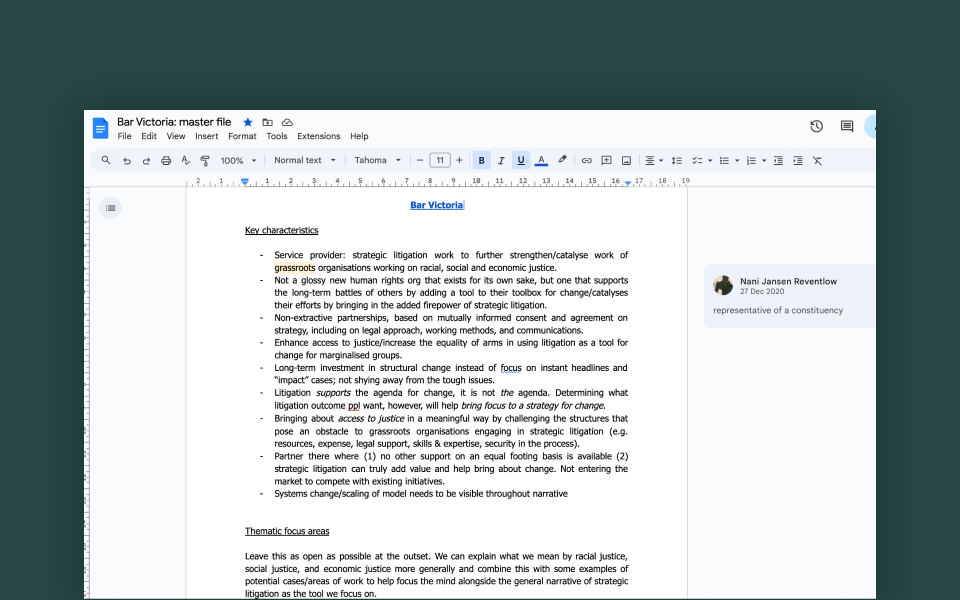
Later that year, Nani started an online document and named it “Bar Victoria”. Together with Jonathan and Andreas Reventlow, they began designing the future organisation: defining its purpose, approach, and scope.  

At the heart of that vision was a commitment to community-led, non-extractive partnerships: an organisation designed not to lead movements, but to support them on their terms, and where communities co-create both the agenda and the role litigation plays within their broader campaigns for change. As importantly, there was a commitment to build a different kind of organisation internally – one guided by its values. 

"Looking back at that Google Doc, it is amazing to see – five years in – how close we've managed to stay to our original vision."

— Nani Jansen Reventlow

2021

FOUNDATIONAL VALUES

Early conversations

Throughout 2021, Nani continued to have one-to-one conversations with potential community partners and lawyers. Among those involved were Susheela Math, then at the Open Society Justice Initiative and later Systemic Justice’s Head of Legal, activists working on racial, social, and economic justice, litigating organisations such as the Dutch Public Interest Litigation Project (PILP), and researcher Patrick Williams, who would later lead the Europe-wide mapping and consultation process.  

The discussions with potential community partners reinforced the belief that if the organisation was going to challenge extractive approaches to strategic litigation, it also needed to challenge them internally – meaning that the principles that shape the work with the communities shape the organisation itself, and ensure its internal structures, culture, and ways of working did not reproduce the hierarchies it challenged through its work.

Defining the values

Before developing programmes or deciding on structures, the founding team – Nani, Jonathan, and Andreas – focused on the principles that would guide every future decision. During a weekend together in late 2021, they articulated three founding values: anti-oppression, intersectionality, and justice.

Photo: Systemic Justice

These values became practical commitments that shape Systemic Justice. Years later, they remain unchanged and continue to define all work, from how the organisation partners with communities and approaches strategic litigation to how it recruits, governs, and shapes its organisational culture.  

Formal registration

By the end of the year, Systemic Justice was formally established in the Netherlands and registered as a stichting (Dutch for “non-profit foundation”). A one-tier board was set up to meet organisational needs as a start-up. 

Systemic Justice became the first Black-founded and majority BPOC organisation in Europe to use a community-driven, intersectional approach to strategic litigation.  

2022

LISTENING FIRST

Mapping and community consultation

Rather than immediately launching programmes or pursuing litigation, Systemic Justice began by listening to communities affected by systemic harms. 

Working with researcher Patrick Williams and his team, the organisation carried out an extensive, first-of-its-kind, Europe-wide mapping and community consultation process to understand the priorities of organisations, movements, and collectives (OMCs) working on racial, social, and economic justice. 

Illustration: Sonaksha

The process combined four elements: a mapping of more than 1,000 OMCs, an online survey, nearly 100 one-to-one conversations, and six thematic roundtables. 

Alongside this, the team analysed existing strategic litigation across the same thematic areas: climate justice, anti-racism, social protection, policing, access to justice, and free movement. 

Comparing community priorities with the issues already reaching the courts revealed a striking gap. The issues communities identified as most urgent were often not the issues reaching the courts. This mismatch highlighted the timely need for community-driven strategic litigation. 

First team retreat, Denmark

The first team retreat took place in Tisvilde, Denmark. The founding team and first collaborators came together to explore Systemic Justice’s Theory of Change, reflect on the organisation’s future direction, and deepen their work on anti-oppressive practice and organisational culture. 

Communities define the priorities

Building on its earlier mapping work, Systemic Justice convened 83 activists, organisers, and advocates from 33 countries across six multilingual roundtables focused on climate justice, anti-racism, social protection, policing, access to justice and free movement. Additionally, nearly 100 people participated via an online survey, and 100 community activists and organisers had 1:1 conversations with the team.  

While the mapping helped identify organisations and communities to engage in the consultation, the roundtables created space for participants to explore common challenges, share experiences, and identify priorities for collective action. 

Climate justice and social protection emerged as priority areas as they met two criteria: communities identified them as urgent, and they remained underserved by strategic litigation that takes an intersectional approach.  

"Surfacing Systemic (In)justices" report launch, the UK

Before finalising the findings, Systemic Justice invited the roundtable participants to test and challenge the conclusions. Two workshops ensured that communities had the opportunity to shape the final analysis before publication. 

This final analysis was published in the Surfacing Systemic (In)justices report launched at a hybrid event in London and attended by nearly 80 activists, organisers, litigators, and funders – in person and online. 

First Community of Practice retreat, France

At the same time, Systemic Justice launched its Community of Practice, a participatory space where litigators, legal practitioners, and litigating organisations can come together.

Sixteen litigators gathered in Vexin, France for the Community’s first in-person meeting to establish shared mission and grounding values: to promote community-centred lawyering and reframe litigation processes. 

Photo: Systemic Justice

The organisations represented span litigation work in the areas of climate justice, LGBTQI+ rights, digital rights, migration, Roma rights, socio-economic rights, and other areas, and working across Armenia, Belgium, France, Germany, Greece, Hungary, and other countries. 

"In order to learn and build knowledge, we need to deconstruct the 'lawyer' in us."

— Community of Practice participant, 2022

Reflecting Systemic Justice’s commitment to anti-oppression and shared power, its role is facilitation rather than direction. It is the Community that co-creates a Community Agreement to set out its mission, values, governance structure, participation guidelines, and agenda

first team & Board retreat, the Netherlands

Earlier in the year, Systemic Justice appointed its first full Board. In November, the team and Board met in person for the first time, using the retreat to explore questions of organisational culture, accountability, and governance models.  

Photo: Systemic Justice

End-of-year traditions begin

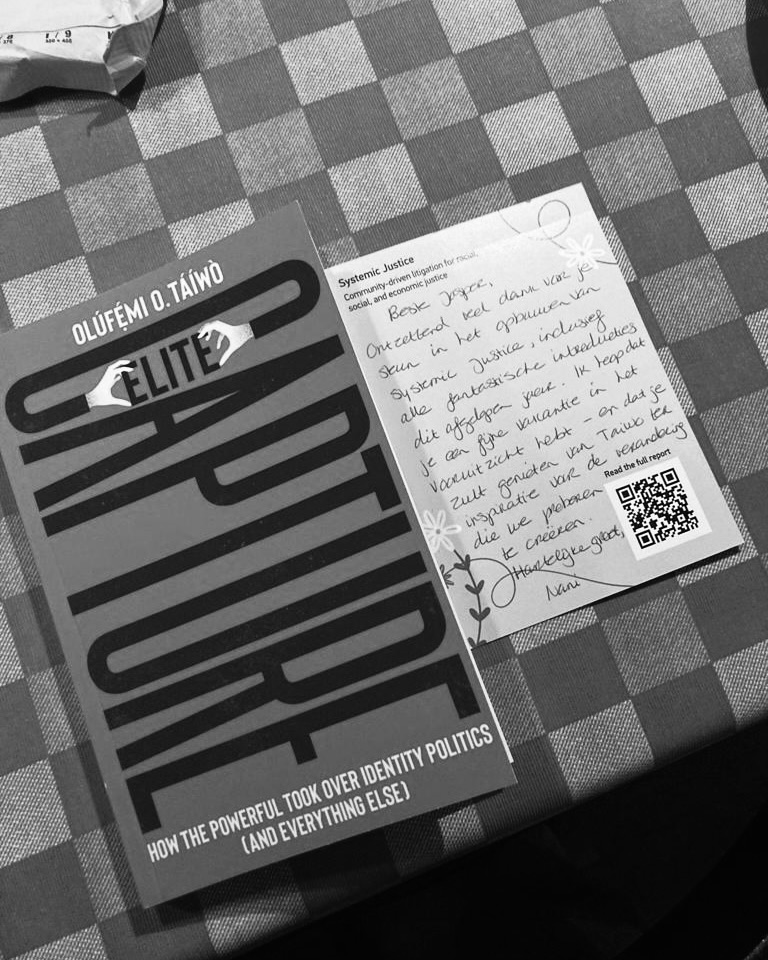
Two end-of-year traditions began: cooking together and sharing a book that speaks to the political questions, challenges, and hopes of the moment. The team gathered online for a cooking workshop to make aubergine curry together, with the book of the year being Elite Capture by Olúfẹ́mi Táíwò.

Photo: Systemic Justice

The book’s examination of how power can become concentrated within progressive movements resonates with many of the questions Systemic Justice was exploring in its early years: who gets to hold power and how to build change without reproducing existing hierarchies. 

2023

FROM PRIORITIES TO PRACTICE


first partnerships

In 2023, the priorities identified during the consultation began to shape Systemic Justice’s day-to-day work.

Systemic Justice began developing partnerships with communities across two priority areas: climate justice and social protection.

As relationships deepen, several potential areas for collaboration emerge, including resisting gentrification, challenging the marketing of harmful beauty products to Black children and women, abolishing racist school exclusions, advancing Intersex rights, and challenging Islamophobia in social protection systems. 

Photo: Mohamad Badarne

One lesson is clear: community-led work moves at the pace of trust, relationships, and community priorities.

This reinforces one of Systemic Justice’s founding commitments: communities most affected by injustice should define both the direction and pace of the work. Rather than driving the process, the organisation adapts to the realities, capacities, and needs of its partners. 

Expanding the map

Building on the 2022 consultation process, Systemic Justice expanded its mapping work across Europe. Working with local consultants, the database grew from over 1,000 to nearly 3,000 organisations, movements, and collectives.

Forty in-depth interviews with community activists provided a deeper insight into how technology contributes to systemic injustice and shapes communities’ experiences of exclusion and discrimination.

Building organisational culture

As partnerships with communities deepened, Systemic Justice also looked inward. With support from an organisational culture consultant, the team spent the year exploring what anti-oppression, intersectionality, and justice mean in everyday practice – from decision-making and accountability to feedback, care, and relationships.

This work helped build a shared framework for working together, one that continues to shape how Systemic Justice works today.

Photo: Mohamad Badarne

New brand identity

Systemic Justice launched a new visual identity rooted in its values, with a comma at the centre: a symbol of connection that brings together movements and the law, communities and litigators, and the many people and organisations working towards systemic change.

The MARTIN typeface used on the new logo was inspired by protest signs from the 1968 Memphis Sanitation Strike and developed by a Black-owned design agency.

BIPOC climate justice speaker series launch, Germany

As climate justice became an increasingly important part of the organisation’s work, the inaugural episode of the Reframing Climate Justice speaker series launched in Berlin. The series consists of five episodes that centre the perspectives of Black, indigenous, and people of colour on climate justice and explore the links between the climate crisis and other systemic harms.

The series also marked the launch of the Building BIPOC Power for Climate Justice initiative, laying the foundations for a broader programme that would expand over the following years through convenings, a podcast, and other projects.

Community Toolkit for Change published

During the conversations with community partners, one request came up repeatedly: a need for practical guidance on strategic litigation written for communities rather than lawyers.

In response, Systemic Justice published the Community Toolkit for Change, a collection of open-access resources designed to help organisers, activists, and movements understand whether and how the law could support their campaigns. The toolkit marked another step in making strategic litigation more accessible to those leading struggles for systemic change

Photo: Mohamad Badarne

The Toolkit is now available in eight languages – Turkish, English, Arabic, French, Somali, Spanish, Danish, Dutch – with more to follow, including an easy-read version.

end-of-year gift

As the year came to a close, the team continued the tradition of sharing a book that reflected the questions shaping its work. In 2023, that book was Hope in the Dark by Rebecca Solnit, whose reflections on social change driven by ordinary people acting collectively resonated with the organisation’s approach to its work.

Photo: Systemic Justice

2024

BUILDING POWER

"Revisiting Systemic (In)justices" report launch, Germany

In June, Systemic Justice brought together activists, organisers, and community partners from across Europe in Berlin to launch Revisiting Systemic (In)justices, an expanded edition of its community consultation.

Across two days, participants shared experiences, created artwork together, and built connections across movements and borders. Guided by the organisation’s values of participation, accessibility, care and relationship-building, the gathering reflected Systemic Justice’s belief that meaningful collaboration begins by creating spaces where communities can learn from one another. Nearly 80 participants gather on the first day, while the second day is open to nearly 50 community partners.

"Together with the many communities who have helped inform this report, we will use the courts to root out and dismantle oppressive power structures."

— Systemic Justice

Expanding conversations on climate justice

Climate justice became an increasingly visible part of Systemic Justice’s work throughout the year.

In September, as part of the Building BIPOC Power for Climate Justice initiative, the organisation launched Whose Planet? The Climate Justice Podcast, centring Black, Indigenous and people of colour in conversations on clean air, rising sea levels, and the green energy transition.

new governance structure

As the organisation continued to grow, its governance structure also evolved to meet its more complex needs. In July, Systemic Justice transitioned from a one-tier to a two-tier governance structure, establishing a Supervisory Board. The new governance structure created a clearer separation between day-to-day leadership and strategic oversight, reflecting the needs of a maturing organisation.

Radical Justice published

In October, Nani published Radicale Rechtvaardigheid (Radical Justice) in Dutch. Drawing on many of the ideas that had shaped Systemic Justice’s early years, the book explores questions of power, justice and collective change, bringing those conversations to a broader public.

What began as a conversation at Victoria Bar was now in print. 

In 2025, the book was published in English by Pluto Press, expanding its reach to an international audience.

"Reclaiming Climate Justice" summit, Denmark

Systemic Justice convened the Reclaiming Climate Justice Summit in Denmark, bringing together participants from across Europe to share experiences, strengthen relationships, and collectively imagine more inclusive climate movements.

"The climate justice summit was a transformative space where we could reflect and brainstorm on strategies that our movement can include more people of the global majority into the climate movement."

— Summit participant

23 participants from across Europe, including Spain, Italy, Norway, Belgium, Greenland, the UK, France, Denmark and beyond gathered for three days of sharing, strategising, and visioning. 

Together, they created a manifesto on their shared vision for climate justice.

end-of-year traditions continued

As in previous years, Systemic Justice closed the year by making space for shared learning and reflection.

In December, everyone received a copy of Raymond Antrobus’s latest poetry collection, Signs, Music. Earlier in the year, he had performed at the June community event in Berlin. Antrobus’s work explores identity, belonging, language and exclusion – themes closely connected to Systemic Justice’s commitment to amplifying voices and experiences often pushed to the margins. The team also gathered online for the end-of-year drinks together. 

2025

A NEW CHAPTER

Leadership transition

In July, founder Nani Jansen Reventlow announced her intention to step down as Executive Director, beginning a carefully planned leadership transition. The decision reflected her longstanding commitment to building an organisation that could continue to grow beyond its founders.

"Systemic Justice has reached a point of maturity where it will benefit tremendously from someone coming in with fresh energy to take it into the next phase following the foundational work and initial building." 

— Nani Jansen Reventlow

The transition reflects a long-held belief that organisations should not be built around individual leaders, but around shared values, strong foundations and collective stewardship.

Nani’s published “Embarking on a joyful leadership transition and the next phase for Systemic Justice”, in which she addressed the failure to normalise leadership transitions, the cultural associations between departures and crises, and the challenges founders – particularly Black women founders – face when they leave organisations they have built. 

Nani reflected on her departure during a conversation at the Leaving Well podcast with Naomi Hattaway. 

Photo: Josimar Senior

In September, Saranel Benjamin joined as Executive Director, bringing extensive experience in movement-building, philanthropy, and decolonial partnerships.

Her appointment marked a new chapter while carrying forward the values of anti-oppression, intersectionality, and justice that have guided the organisation from the beginning. 

Saranel shared that joining Systemic Justice feels like homecoming.  

“Justice, to me, is about righting the systemic wrongs that perpetuate racial, social, and economic inequalities: harms that continue to disproportionately affect Black, Indigenous, and People of Colour (BIPOC). When we fight for justice, we are fighting for the liberation of BIPOC people through the dismantling of the intersecting systems of oppression.”

— Saranel Benjamin

A new chapter for the legal programme

Also in July, founding Head of Legal Jonathan McCully stepped down after helping establish the organisation’s legal methodology, Community of Practice, and community-led approach to strategic litigation.

He was succeeded by Susheela Math, who brought 20 years of legal experience, with a strong focus on litigation, equality, and human rights. A generous handover period helped ensure continuity as she takes on the role. 

Photo: Systemic Justice

"My real excitement [to have joined Systemic Justice] stems from having the opportunity to learn more about, and to further, Systemic Justice’s inspirational vision and mission for change: ensuring that communities affected by racial, social, and economic injustice can use their power to seek justice in the courts, on their own terms."

— Susheela Math

Building knowledge and power

Throughout the year, Systemic Justice continued to bring together community organisations, movements, and collectives to share knowledge, strengthen relationships, and explore how strategic litigation could support community-led change.

One example was a climate justice gathering in Amsterdam, where organisations from across the Council of Europe came together to exchange experiences, develop strategies, and build connections across borders.

Traditions continue

The year closed with the team’s first in-person end-of-year gathering in Amsterdam. Alongside cooking together and exploring the city’s Black history, the team continued its tradition of sharing a book that reflected the questions shaping the organisation’s work.

In 2025, that book was One Day, Everyone Will Have Always Been Against This by Omar El Akkad, a reflection on solidarity, moral responsibility, and the refusal of indifference in the face of injustice.

2026

THE WORK CONTINUES

Five years after its founding, Systemic Justice continues to work alongside communities fighting for racial, social and economic justice across the Council of Europe, using strategic litigation as one tool for achieving systemic change.

Founded in 2021 by human rights lawyer Nani Jansen Reventlow, the organisation emerged from a commitment to centre those most affected by injustice in the legal strategies intended to support them. That commitment continues to guide Systemic Justice’s work today.

As the first Black-founded and majority BPOC organisation in Europe to centre a community-driven, intersectional approach to strategic litigation, Systemic Justice remains grounded in its founding values of anti-oppression, intersectionality, and justice.

Under the leadership of Executive Director Saranel Benjamin, the organisation is building on the foundations of its first five years while developing its next strategic plan, informed by the relationships, learnings, and reflections that have shaped its journey so far.

On 29 June 2026, Systemic Justice marked its fifth anniversary with an event for its community partners, peers, and supporters. During the evening, Founder Nani Jansen Reventlow reflected on the organisation’s first five years, while Executive Director Saranel Benjamin shared her vision for the future.

The event included an exhibition to celebrate the work of the communities and organisations that have shaped our journey. The carousel below highlights the organisations featured in the exhibition.