
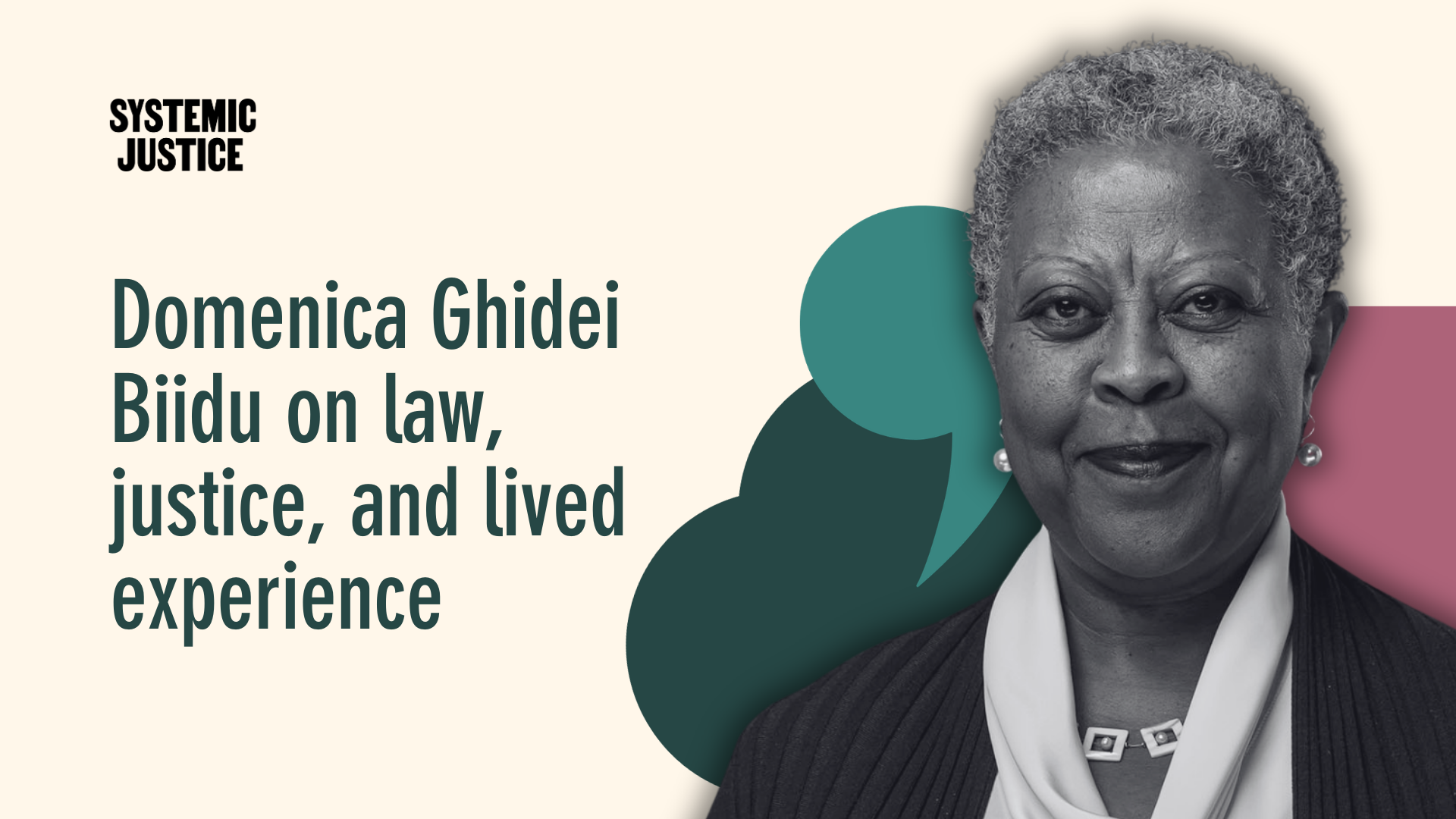
On 10 March, the International Day of Women Judges, we celebrate the women shaping justice systems around the world. One of them is Domenica Ghidei Biidu – a long-time deputy judge in the Netherlands, former Human Rights Commissioner at the Netherlands Institute for Human Rights, Vice Chair of the European Commission against Racism and Intolerance, and a member of the Systemic Justice’s Supervisory Board.
Her journey into the law began long before these roles, shaping her understanding of justice not only by legal theory but by lived experience. In this conversation with Systemic Justice, she reflects on the philosophical roots of justice, the realities of working within legal institutions, the power of community-driven strategic litigation, and why hope remains a conscious and necessary choice in the struggle for a more just world.
Domenica, you have served as a deputy judge for more than 20 years and have also held roles such as Human Rights Commissioner and Vice Chair of the European Commission against Racism and Intolerance (ECRI). What initially drew you into this field of work?
Well, it starts with the question: why did I study law? For me, it was really that I like law very much because it works on different levels. You have the philosophical idea about law, and you also have the practical part – the agreements, the structures, the way societies organise themselves. I like both of them.
There is this philosophical notion of justice, which is really part of humanity on very different philosophical grounds. It has to do with ideas of dignity. Values like justice and dignity are very important for us as human beings living in a social environment where we live together, share space, interact, and have to agree on certain things.
So the question becomes: what is the basis of justice? Where does it come from? I believe justice is inherent to humanity. The question is whether we see it and whether we abide by it. I believe there is an innate sense of justice within each of us. We also know it when that sense of justice has been infringed. It is part of our nature. Of course, because of (generational) oppression, fear, survival instinct, or many other factors, we do not always recognise it, listen to it, or adhere to it. But my belief is that there is a sense of justice in all of us.
How did your personal experiences shape your understanding of justice?
My interest in justice was not only philosophical; it was also visceral, intrinsic, and deeply personal. I experienced oppression from a very young age. So from an early age, I learned to recognise, name, and make sense of what was happening around me. Especially when something did not feel right, even when what I was witnessing was not interpreted or explained to me by adults. Still, I sensed that there was a struggle taking place.
In Eritrea, first under colonial rule and later in the post-colonial period, violence and repression were part of everyday life. Atrocities were committed, and language and cultural expression were suppressed. Not being allowed to learn your own language, seeing communities oppressed, witnessing the struggle for independence and self-determination, and living in a context where the rule of law was absent, these were not distant political realities. They were part of the environment in which people lived their lives.
I saw how these circumstances affected families and individuals. The fear, the loss, the resilience, and the quiet ways people tried to protect one another. Through these experiences, injustice became something very concrete and tangible for me. It was never an abstract idea.
Later, when full-fledged war broke out, and I had to leave my country, the whole notion of asylum, refuge, and justice became part of my life as well. During that time, I discovered something important: that people in the world had agreed on certain parameters – certain thresholds of what we say should not happen. That is when I discovered international law and human rights law. It meant that there were frameworks people could claim and use in order to fight for more justice. But of course, there is always a difference between having laws and making them work in practice, especially for marginalised individuals and communities.
At what point did you realise that studying law was the path you wanted to follow?
As a refugee, my trajectory eventually brought me to the Netherlands. I applied for asylum and received protection. I also worked with many grassroots organisations – predominantly with refugees, asylum seekers, and with Black, migrant, and refugee women. That made me think: where do we show that we are civilised societies?
One way is through structures – institutions, rules, laws, and regulations. We must have institutions where states and governments are held accountable and where people can go when their rights are violated, where they can complain, and where independent structures can ensure justice. This fascinated me. That is when I decided to study law, because I wanted to understand the fabric of law and the infrastructure of institutions and learn how to use it to help bring about justice.
For me, being a student at the Vrije Universiteit Amsterdam was really like walking around in a candy store. I loved studying and discovering things. At the same time, I realised that the starting point of much of what we studied was very Eurocentric. So I thought: then I need to find other authors and thinkers whose perspectives resonate with my lived experience. This was before the Internet. So you had to go to the library, search for books, and go to different lectures and places. But that whole process of discovery was fascinating.
And I also saw how people across the world had challenged injustice – through the civil rights movement, through struggles for collective and individual rights, through independence movements in Africa, Latin America, the Caribbean, Asia, and more. In the end, everything has to do with power: who has the power to bring ideas forward and translate them into conventions and laws and make institutions effective. Every effort to expand justice is important. Unfortunately, we know that this process has not worked in favour of the global South and the majority of the world’s population.
So my motto has always been: try to contribute something that makes the world more just. The rights we have today were not given to us for free. People fought for them; many had died to assure us these rights. They were not served to us on a golden plate. That means we must keep refining them, understanding them, and expanding them.
When I had the opportunity to become a judge, I really wanted to do it. One thing is having laws and regulations written on paper. Another thing is translating those rules so that people can actually have their rights respected. That is why institutions are so important. So I applied to become a deputy judge, and I was accepted.
At the time, I worked in vreemdelingenrecht (Dutch Immigration law). But the legislation was revised during that period, and it was not always a very productive moment to work as a deputy judge. If I had been practising as an advocate, it might have been different.
I came from grassroots organising and academic study, and the administrative law system can be quite bureaucratic. Often, you look more at whether procedures were followed than at the substance of the issue. At times, this was deeply frustrating. It was not the place to challenge the very foundations of migration and refugee law, including the racialised logics that have shaped both its conception and its implementation, with profound consequences for many communities and individuals.
Of course, procedures are important, and I still value administrative law very much. But I felt it did not allow the broader systemic contribution I wanted to make.
How did you then later become involved in human rights institutions?
I have often been lucky in my life – being in the right place at the right time. At one point, I was approached and asked whether I would consider becoming an Equal Treatment Commissioner. I applied and was appointed. Later, the Equal Treatment Commission in the Netherlands became the Netherlands Institute for Human Rights, and I became a Human Rights Commissioner there. For about twelve years, this was my core work. It is a semi-judicial body – we are not judges, but the people appointed must have the same legal qualifications as judges.
I really liked this work. It involved translating everyday experiences of discrimination into legal analysis. People would come with the perception that they had been discriminated against, and we would investigate the case carefully.
Even though we could not award compensation, and the judgments or opinions were not binding, stating that discrimination had occurred was very meaningful. The recognition and the procedure gave the plaintiff a sense of procedural justice. It helped people, and it pushed institutions to change.
When did you first encounter strategic litigation?
Through this work, I also became part of a European network of equality bodies called Equinet. That was really when I became aware of strategic litigation at the European level. Because EU directives and human rights frameworks apply across many countries, a legal interpretation in one case can affect many others. For example, when an equality body in the UK or France is involved in a landmark case, we would analyse it together, explore its broader implications, and decide on strategic interventions, such as submitting an amicus curiae brief.
Decisions from the Court of Justice of the European Union or the European Court of Human Rights often ripple far beyond the country where the case originated, shaping legal standards and influencing human rights protections across many EU and Council of Europe member states. A decision on an issue in one country can have implications for many others. That was when I truly understood the importance of strategic litigation: it is not only about resolving a single case, but about creating legal precedents and interventions that strengthen protections for marginalized communities across borders.
What drew you to the work of Systemic Justice?
What I like about Systemic Justice is that it is very community-oriented. Communities themselves take the lead in defining what they want and how they want to achieve it. The ownership remains with them. At Systemic Justice, we support and help make things possible. There is also a Community of Practice where people work together and exchange ideas. For me, this is very important. It means really listening to communities and ensuring their voices are heard. It means practitioners are not imposing their own agendas or using communities as instruments.
What has your experience been navigating institutions as a BPOC practitioner?
It is not always easy to work within structures that were not (necessarily) designed for us. As judges or practitioners of colour, navigating institutions requires awareness and resilience. There is solidarity and support from others, but it can also feel lonely sometimes.
This is because these issues at stake in many cases are not abstract. They are triggered by lived experiences that remain within us. You cannot simply leave them behind at the end of the day. There is always a balance to find. Unfortunately, courts and Human Rights institutions do not always reflect the core values upon which they were founded. They can be unsafe spaces, marked by power struggles and (institutional) discrimination.
At the same time, when I work in an institutional role, I am not the spokesperson of a community. I carry my lived experience with me, but I use it as a way to understand situations and ask certain questions. That distinction is important for doing the work well. And that is something I still value very much in the work I continue to do. This is precisely the added value of having people involved in strategic litigation who can relate to the challenges faced by communities. They can have an intrinsic proximity to those experiences while also remaining clear about their role. Being transparent, honest, and ethical in one’s work and in managing expectations is essential. It is equally important not to carry a burden that does not belong to one’s responsibility.
What gives you hope when you think about the fight for justice?
I think hope is a choice. It is a choice to have what I would call radical hope. It is also a commitment – to use our circle of influence to do what we can to make the world a better place. Right now, we see the international human rights order being challenged. Sometimes, when courts make judgments, there are attacks on judges or institutions. Judges themselves can be threatened.
All of this is happening. That is why solidarity is so important. Speaking up matters. Doing what is within our power matters. For me, hope is not based on the expectation that things are going to go well. It is something we must choose even when things are uncertain and difficult. In a way, it is an obligation and an invitation to collective imagination, to shared struggles and solidarity.
After all these years of personal and professional experience, how do you define justice?
That is a very large and beautiful question. Justice is such a basic part of life. We are relational beings, so justice becomes part of the balance that allows us to live together. But justice is not something fixed. It is not something you can grasp and put in a box and say: here it is. Justice is fluid. It changes all the time, but it is always present. In everyday life, there can be justice in a moment, and an hour later it may disappear. So it is very powerful, but also very fragile.
There are some things you cannot fully put into words – otherwise they become flat and two-dimensional. Justice, hope, love – these are things you recognise when you experience them. Or you can feel their absence. You know when you are within them, and you know when you are not. Because we recognise injustice and because we are able to discern between justice and injustice, we create laws and institutions to address it.
At the same time, in our interactions as communities, we create spaces to explore these questions and to work together in the spirit of radical hope and justice in the age of BANI (brittle, anxious, non-linear, and incomprehensible) in which we are living.
That, for me, is how I understand justice.